


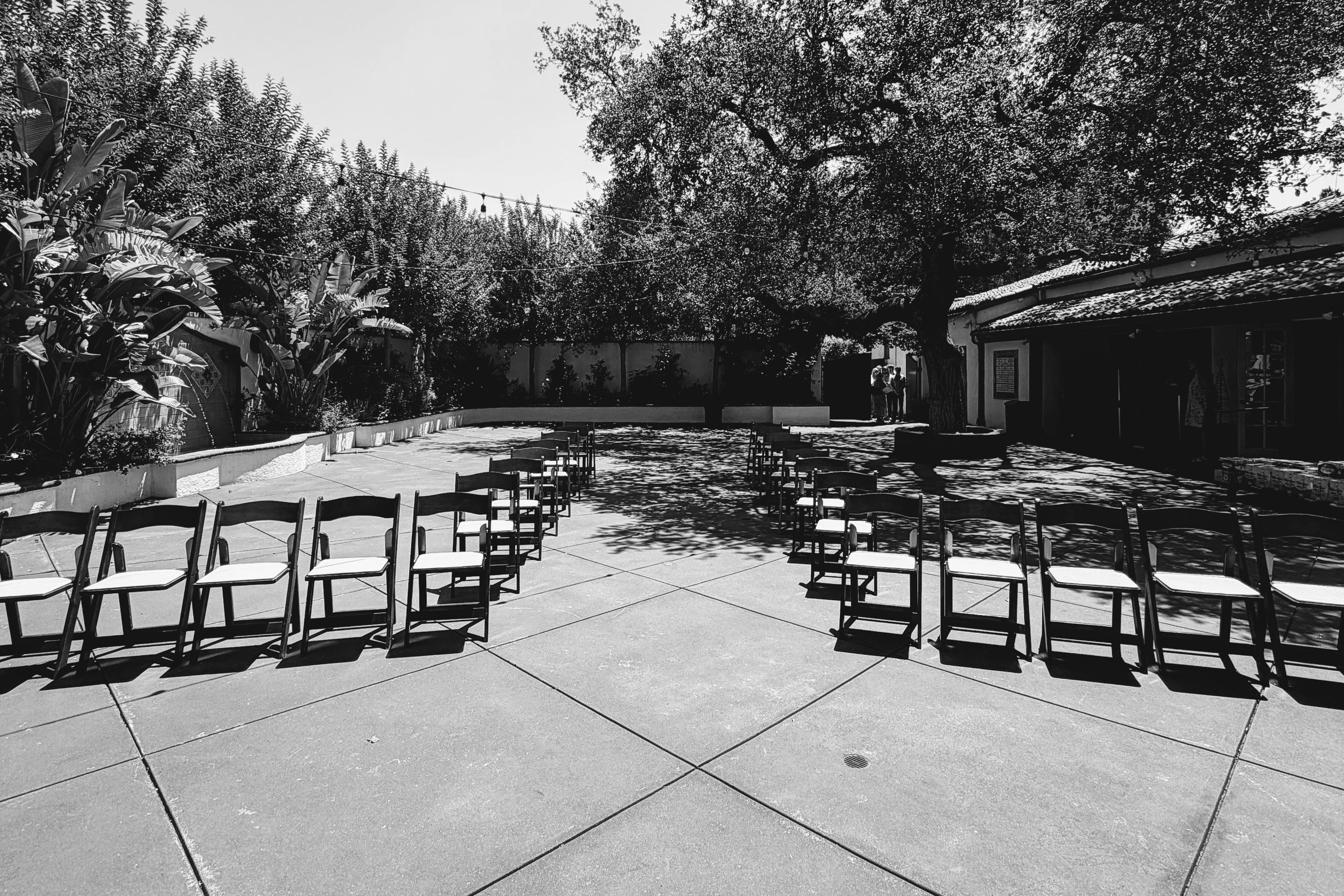
When my friends asked me to officiate their wedding, I didn’t just copy and paste the words and rituals I had seen at other weddings. I started over from scratch.
Starting over is part of my process as an artist. I blow everything up and rebuild it. Sometimes multiple times before the project is complete. It’s not efficient. But who said art is supposed to be?
Officiating is art? Yes. It’s a performance. One designed to conjure a very specific type of energy—a sense that this moment is important. Ceremonial. And a sense that this moment is specific to these—and only these—two people. Words, in the right order, are powerful spells that can truly transform us. Unfortunately, all too often the spell doesn’t work because the words are just copied from another wedding the couple went to. Or one they saw go viral on TikTok.
There’s actually a term for this called cargo culting, in which someone imitates the visible form of something that worked without understanding the underlying mechanisms that made it work or the purpose behind it. Quick nerdy example: when I was in film school, I’d often see directors record audio directly into the camera. But they’d still clap the film slate. Which is hilarious if you understand that the only reason to clap a film slate is to sync audio that’s recorded on a separate device.
Aesthetic, check. Underlying purpose, meh.
I take notes at every wedding I go to. And I’ve been to quite a few. I started the list for “my own wedding one day if I ever decide to have a wedding.” Here are a few of my favorites:
Please let’s do upbeat instrumental music (jazz?) as guests come in before the ceremony seating. Why is this music so forlorn? Am I actually at a funeral?
Why does the officiant feel like they’re trying to “get through it”? Too fast, not enough pauses. Where’s the presence?
The centerpieces on this table are so tall and wide I can’t fucking see half the people sitting across from me.
Have my mom start her speech with, “Jesse’s always been like a son to me.”
In preparation for my officiating, I used this list as the starting point for what to do/what not to do. I watched around five 20-minute ceremonies on YouTube titled “best officiant ever.” I then Googled the most common ceremony structures to know what’s generally expected (the suggested scripts were truly Hallmark-greeting-card oof-o-rific: “Their journey together began over coffee and small talk, and has grown into a life filled with laughter and long hikes.” Yikes!). I used Claude to research the top most-used lines in officiant speeches so I could avoid using them (“rings are circles and circles have no beginning and no end, just like their love…” Oh, I’m sorry, I didn’t realize we were dual-enrolled in geometry).
Once the outline was roughed out, I refined it off and on for weeks, massaging it until only the essential pieces remained. By this point, I had met with the couple twice, in person, to go over their expectations. They were pleasantly flexible with the structure, but foundationally, they wanted a traditional ceremony. Which was why I didn’t have a gunshot sound go off as the champagne flute in my hand exploded while the Mission: Impossible theme erupted, kicking off a full-scale choreographed fight scene (an actual item in my notes). Large-scale viral bits weren’t organic to the experience this couple wanted. Instead, I leaned into showcasing the genuine friendship the couple had. They’re in love, sure. But they’re best friends who laugh together constantly, and that is so tangible that I wanted to make that the emotional centerpiece (but still low enough that you could see the fucking people across from you at dinner).
This is where I landed:
Walk
This is where the groom walks down the aisle, followed by the family, who all sat in the front row. No wedding party. Pretty simple, not much to reinvent here.
Frame
The Frame is where I welcomed everyone and said things about the couple. This is the most important part because it sets the tone for the entire wedding, which for me was emotional, authentic, and funny. I opened with: “Before we dive in, I just want to take a genuine moment to thank everyone for coming out today… [beat] for this special dress rehearsal for the real wedding next Saturday. Some of you even flew in. So much dedication.” By opening with an unexpected joke, I’m saying: we’re having fun up here, which means you can have fun, too.
A huge part of my setup involved simply talking us all through what it means to actually be present: “That thing you have been waiting for, that thing all of us have been waiting for—the wedding—is this. And in a moment, I’m going to ask everyone to collectively take a deep breath in and sigh it out. And when you hear everyone sigh, listen carefully to the relief that you hear and feel. A relief that we’re no longer rushing to get here. A relief that we’re not in traffic. That the errands have ceased. That we have arrived. And that this is not a dress rehearsal, deep breath in [take a deep breath]… sigh it out. We rush because it distracts from the present. Because when you’re truly present, you’re feeling what’s actually happening, not what happened yesterday or what might happen tomorrow. Your actual present reality. And that’s intense. Even good feelings are sometimes intense because a lot of us have learned that they’re a warning that the other shoe is going to drop. But we can actually just decide to welcome real joy and not run away from it or be cynical about it. I’m not going to be able to tell you something about love that you haven’t already heard or tell you an anecdote that could possibly communicate who these two beautiful people are more than their own vows will. But what I can do is remind you how important it is to trust yourself to be yourself at this wedding.”
I Do’s + Vows
Why did I spend so much time talking about presence and emotions? Because the couple shared their vows with me a week before the wedding, and in reading them, I realized I didn’t want to talk about love or “their story” because it could never resonate as much as their own words would. So I focused on priming everyone to, as Buddha would say, pay the fuck attention so that the reality of what the couple said could actually land.
Something else that I was super jazzed about structurally that the couple was down for was combining the I do’s and the vows, which flowed like this: “Do you take this woman to be your wife?” “I do.” “And you’ve made promises to that effect?” “I have.” “Please, tell us what those are.” And then the groom read his vows. Afterward, I said the same thing to the bride. For me, it was a no-brainer upgrade to the traditional script and the couple agreed!
Ring Exchange
I figured following the very grounded and emotional vows moment, it would be a good time to season the emotion with another joke, so I said, deadpan: “In lieu of rings, the couple has chosen to participate in their family’s historic tradition, where they stand inside a ring of fire on the ground while various family members throw cups of water on them in an attempt to prevent them from catching fire. [Beat, look to the back.] Oh, wait a second, sorry, I’m getting told by the coordinator that we cut this part. I did arrive a few minutes late to rehearsal, so that’s on me.”
Then I bounced back to emotion and talked about what love is. And then I asked everyone to be completely silent while the rings were exchanged. Why silent? Because “with this ring, I thee wed” sounded like I was marrying Henry V and Catherine (tbh had to Google who his wife was). I had never seen a silent ring exchange, but I knew that it would be a memorable moment for the couple and the audience.
After the silence, I had the couple stare at each other while I said, “While we all claim we want love, often when it’s staring us right in the face, we actually run away from it.” And at that exact moment, the bride ran down the aisle and left. Just kidding but DAMN could you imagine? I continued, “We run from love because if we agree to love, we risk being hurt. But that’s the chance we have to take. That’s literally faith. Faith that the choice to show ourselves—our full selves—results not in judgment but in unconditional acceptance of who we are today, and who we will become.”
Community Vows
“But we don’t become ourselves on our own, or even as a couple. It takes an entire community. Please, turn to face your community.” The couple looked out at the audience, and I said, “Do you all promise to take these two, to celebrate and support them from this day forward—for better, for worse, for richer, for poorer, in sickness and in health—to show up for them, and to hold them to the promises they’ve made here, for as long as they both shall live—and if you do, please stand up from your seat and say, out loud, ‘I do.’” No one—including the couple—knew that this was going to happen. But everyone in the audience stood up and said, “I do” in unison. I wanted a component of audience participation, and I had never seen anything like this before. In my mind it was a bit like, “I’m Spartacus.” “No, I’m Spartacus!” It created a sense that we’re all in the health of this marriage together, because, well, we are.
Pronouncement + Kiss
“Well then, by the power vested in me by the State of California—and the support of your community—I now pronounce you husband and wife. You may kiss!”
Notice I didn’t say, “You may now kiss the bride.” When I was blowing up the script and analyzing the tropes, this felt like an obvious change so that both the man and woman stand together as equals, not as whatever sort of property-trading patriarchy nonsense was going on when these words were originally written.
Presentation
“I now present to you—for the first time ever—Mr. [Husband’s Full Name] and Mrs. [Wife’s First Name] [Husband’s Last Name].”
Walk Redux
Bride and groom walk down the aisle and exit.
Family leaves in reverse order of how they came in.
Announcements
Thanks to Priya Parker and her incredible book The Art of Gathering, I learned never to start or end with “business.” Meaning, if there are logistics to cover, try and wedge it in the middle. So when I was asked if I could tell people that we’re now moving to cocktail hour, I knew I had to figure out how to say it in such a way that it didn’t come across as “oh and also, whoever has the red Honda Civic with the license plate HOTZA$$, you’re blocking the catering truck.”
So this is what I came up with: “For some of you here today, this may be your first wedding. For others, your 10th. We’re about to transition into cocktail hour while they set up dinner, and if you need to use the restroom, please sneak in and use it and then rejoin us outside. But one thing I want to really emphasize regardless of how many weddings you’ve been to: lean in. Many of us don’t know each other, but we know the couple—and that thread connects us, and that’s all we need to give ourselves permission to walk up to someone we don’t know and compliment their dress or their tie or their shoes. Or dance with a stranger. Truly, the best way you can show up for this couple tonight is to get to know this new family we’re all now a part of. Thank you all, and have a wonderful evening.”
Notice that the logistic announcement is wedged in the middle of a purpose-infused invitation. Sweet.
Being asked to officiate this wedding was one of the biggest honors of my life. Executing it was one of the biggest highlights of my life (being asked by two people afterward to do their weddings was a nice bonus… even if one of them was only 22 years old and single). Every time I stand in front of a group of people, I’m reminded of my ability to cast the spell of connection. I love casting it. I also love seeing others light up when they realize something is going to be a 20% more delightful and engaging than they thought. I am grateful for the mindfulness training I’ve done to become someone who can be present and share the power of presence with others (thanks, Sam Harris). And I’m thrilled for the many more journeys ahead, bringing as many people together as I can along the way.
Oh I'm so sending this to my officiant now
Of course, my favorite part is, “Have my mom start her speech with, “Jesse’s always been like a son to me.’” 😆
The time involved in writing this was no doubt a labor of love, and reading it brought so many emotions. I’m so proud of the man you’ve become and grateful for the people who have been part of your journey. Life has a funny way of bringing the right people into our lives and creating memories we carry with us forever.
And yes, I’ll gladly start my speech exactly as requested. ❤️